5. Analysis Results
Below, we present C4 model analysis for each of the three haiku.
5.1. First Haiku: "Inochi Futatsu No Naka Ni Ikitaru Sakura Kana"
5.1.1. Context Diagram (Contextual Layer)
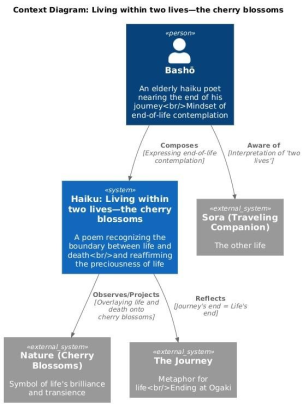
Figure 1. Context Diagram of the First Haiku ("Inochi futatsu...") Context Diagram of the First Haiku ("Inochi futatsu...")
Diagram Explanation:
This poem expresses Bashō's end-of-life mindset near the end of his journey. Through the expression "two lives" (inochi futatsu), he becomes aware of the boundary between the life that lives and the life that must die. Using cherry blossoms as a natural medium, the structure looks at one's own existence and life's end. External environmental factors-fatigue from the journey, physical decline, and Ogaki as the journey's destination-exert influence.
PlantUML Code:
@startuml
!include https://raw.githubusercontent.com/plantumlstdlib/C4-PlantUML/master/C4_Context.puml title Context Diagram: Living within two lives-the cherry blossoms
Person(Bashō, "Bashō", "An elderly haiku poet nearing the end of his journey
Mindset of end-of-life contemplation")
System(haiku, "Haiku: Living within two lives-the cherry blossoms", "A poem recognizing the boundary between life and death
and reaffirming the preciousness of life")
5.1.2. Container Diagram (Container Layer)
System_Ext(nature, "Nature (Cherry Blossoms)", "Symbol of life's brilliance and transience")
System_Ext(journey, "The Journey", "Metaphor for life
Ending at Ogaki")
System_Ext(companion, "Sora (Traveling Companion)", "The other life")
Rel(Bashō, haiku, "Composes", "Expressing end-of-life contemplation")
Rel(haiku, nature, "Observes/Projects", "Overlaying life and death onto cherry blossoms")
Rel(haiku, journey, "Reflects", "Journey's end = Life's end")
Rel(Bashō, companion, "Aware of", "Interpretation of 'two lives'")
@enduml
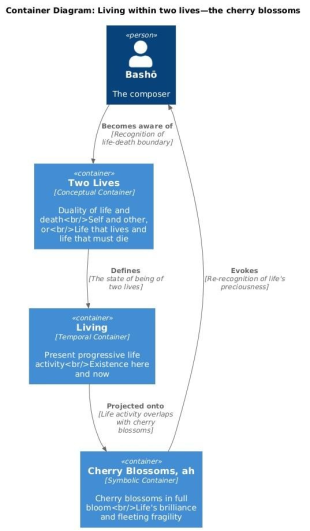
Figure 2. Container Diagram of the First Haiku ("Inochi futatsu...")
Diagram Explanation: container representing the duality of life and death. "Living"
We identify three major elements-"containers"-compos- (ikitaru) is a temporal container indicating ongoing life activing the poem. "Two lives" (inochi futatsu) is a conceptual ity in the present progressive form. "Cherry blossoms, ah" (sakura kana) is a physical container symbolizing natural beauty and impermanence. These three interact to generate the poem's overall meaning.
Plain explanation: Think of these containers like nested boxes, each holding different aspects of meaning. The outermost box is the concept of dual existence, inside that is the experience of being alive now, and at the center is the concrete image of cherry blossoms that brings it all together.
PlantUML Code:
@startuml
!include https://raw.githubusercontent.com/plantumlstdlib/C4-PlantUML/master/C4_Container.puml title Container Diagram: Living within two lives-the cherry blossoms
Person(Bashō, "Bashō", "The composer")
Container(inochi, "Two Lives", "Conceptual Container", "Duality of life and death
Self and other, or
Life that lives and life that must die")
Container(ikitaru, "Living", "Temporal Container", "Present progressive life activity
Existence here and now")
Container(sakura, "Cherry Blossoms, ah", "Symbolic Container", "Cherry blossoms in full bloom
Life's brilliance and fleeting fragility")
Rel(Bashō, inochi, "Becomes aware of", "Recognition of life-death boundary")
Rel(inochi, ikitaru, "Defines", "The state of being of two lives")
Rel(ikitaru, sakura, "Projected onto", "Life activity overlaps with cherry blossoms") Rel(sakura, Bashō, "Evokes",
"Re-recognition of life's preciousness")
@enduml
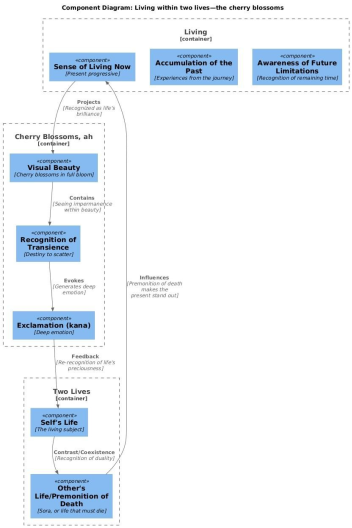
Figure 3. Component. Diagram of the First Haiku ("Inochi futatsu...").
5.1.3. Component Diagram (Component Layer)
Diagram Explanation:
We break down the functional elements within each container. The "Two Lives" container has two components: "Self's life" and "Other's life (or premonition of death)." The "Living" container consists of "Sense of living now," "Accumulation of the past," and "Awareness of future limitations." The "Cherry Blossoms, ah" container includes "Visual beauty," "Recognition of transience," and "Exclamation (kana)," an emotional response. The interaction of these components forms the poem's deep meaning.
PlantUML Code:
@startuml
!include https://raw.githubusercontent.com/plantumlstdlib/C4-PlantUML/master/C4_Component.puml title Component Diagram: Living within two lives-the cherry blossoms Container_Boundary(inochi_boundary, "Two Lives") {
Component(self_life, "Self's Life", "The living subject")
Component(other_life, "Other's Life/Premonition of
Death", "Sora, or life that must die") }
Container_Boundary(ikitaru_boundary, "Living") {
Component(present, "Sense of Living Now", "Present progressive")
Component(past, "Accumulation of the Past", "Experiences from the journey")
Component(future, "Awareness of Future Limitations", "Recognition of remaining time") }
Container_Boundary(sakura_boundary, "Cherry Blossoms, ah") {
Component(visual, "Visual Beauty", "Cherry blossoms in full bloom")
Component(transience, "Recognition of Transience", "Destiny to scatter")
Component(exclamation, "Exclamation (kana)", "Deep emotion") }
Rel(self_life, other_life, "Contrast/Coexistence", "Recognition of duality")
Rel(other_life, present, "Influences", "Premonition of death makes the present stand out")
Rel(present, visual, "Projects", "Recognized as life's brilliance")
Rel(visual, transience, "Contains", "Seeing impermanence within beauty")
Rel(transience, exclamation, "Evokes", "Generates deep emotion")
Rel(exclamation, self_life, "Feedback", "Re-recognition of life's preciousness")
@enduml
5.1.4. Extraction of End-of-life Planning and Well-being Elements
Analysis Results:
1. Acceptance of the Duality of Life and Death:
The expression "two lives" presents a perspective that views life and death not as opposites but as two coexisting aspects. This connects to "overcoming the fear of death" in endof-life planning.
2. Intensity of Living in the Present:
The present progressive form "living" (ikitaru) expresses the attitude of living this moment with full strength while recognizing the finitude of remaining time. This is an element of well-being: "mindfulness focused on the present."
3. Unity with Nature:
Through the beauty and transience of cherry blossoms, one recognizes that one's own life is also part of nature. This is the core of spiritual well-being: "a sense of belonging to something greater."
5.2. Second Haiku: "Hamaguri No Futami Ni Wakare Yuku Aki Zo"
5.2.1. Context Diagram (Contextual Layer)
Diagram Explanation:
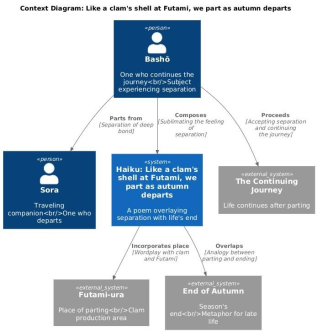
This poem deals with the specific scene of human relationships: the parting from Sora at Ise's Futami-ura. Through the metaphor "like a clam at Futami" (hamaguri no futami), it expresses the separation of two beings with a deep bond, while "departing autumn" (yuku aki), the season's end, hints at life's conclusion. This expresses the important theme of "organizing relationships" in end-of-life planning.
PlantUML Code:
@startuml
!include https://raw.githubusercontent.com/plantumlstdlib/C4-PlantUML/master/C4_Context.puml title Context Diagram: Like a clam's shell at Futami, we part as autumn departs
Person(Bashō, "Bashō", "One who continues the journey
Subject experiencing separation")
Person(sora, "Sora", "Traveling companion
One who departs")
System(haiku, "Haiku: Like a clam's shell at Futami, we part as autumn departs", "A poem overlaying separation with life's end")
System_Ext(futami, "Futami-ura", "Place of parting
Clam production area")
System_Ext(autumn, "End of Autumn", "Season's end
Metaphor for late life")
System_Ext(journey_continues, "The Continuing Journey",
"Life continues after parting")
Rel(Bashō, sora, "Parts from", "Separation of deep bond")
Rel(Bashō, haiku, "Composes", "Sublimating the feeling of separation")
Rel(haiku, futami, "Incorporates place", "Wordplay with clam and Futami")
Rel(haiku, autumn, "Overlaps", "Analogy between parting and ending")
Rel(Bashō, journey_continues, "Proceeds", "Accepting separation and continuing the journey") @enduml
Figure 4. Context Diagram of the Second Haiku ("Hamaguri no..."). Context Diagram of the Second Haiku ("Hamaguri no...").
5.2.2. Container Diagram (Container Layer)
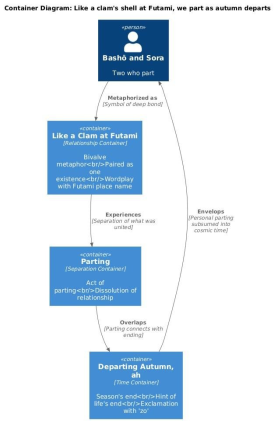
Figure 5. Container Diagram of the Second Haiku ("Hamaguri no...").
5.2.3. Component Diagram (Component Layer)
Diagram Explanation:
We identify the major components of the poem: "Like a clam at Futami" (metaphorical container for relationship), "Parting" (container for the act of separation), and "Departing autumn, ah" (container for time and ending). These work hierarchically so that personal separation is elevated to universal life's end.
PlantUML Code:
@startuml
!include https://raw.githubusercontent.com/plantumlstdlib/C4-PlantUML/master/C4_Container.puml title Container Diagram: Like a clam's shell at Futami, we part as autumn departs
Person(Bashō_sora, "Bashō and Sora", "Two who part")
Container(hamaguri, "Like a Clam at Futami", "Relationship Container", "Bivalve metaphor
Paired as one existence
Wordplay with Futami place name")
Container(wakare, "Parting", "Separation Container", "Act of parting
Dissolution of relationship")
Container(yukuaki, "Departing Autumn, ah", "Time Container", "Season's end
Hint of life's end
Exclamation with 'zo'")
Rel(Bashō_sora, hamaguri, "Metaphorized as", "Symbol of deep bond") Rel(hamaguri, wakare, "Experiences", "Separation of what was united")
Rel(wakare, yukuaki, "Overlaps", "Parting connects with ending")
Rel(yukuaki, Bashō_sora, "Envelops", "Personal parting subsumed into cosmic time")
@enduml
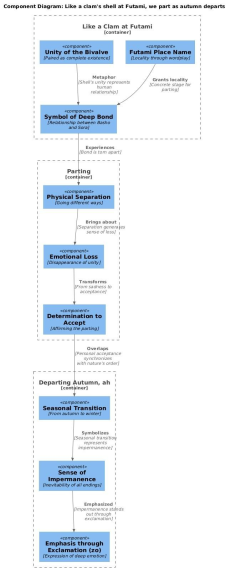
Figure 6. Component Diagram of the Third Haiku ("Araumi ya...")
Diagram Explanation:
We show detailed elements composing each container. "Like a clam at Futami" consists of "Unity of the bivalve," "Futami place name," and "Symbol of deep bond." "Parting" includes "Physical separation," "Emotional loss," and "Determination to accept." "Departing autumn, ah" comprises "Seasonal transition," "Sense of impermanence," and "Emphasis through exclamation." The complex interaction of these elements generates the poem's multilayered meaning.
PlantUML Code:
@startuml
!include https://raw.githubusercontent.com/plantumlstdlib/C4-PlantUML/master/C4_Component.puml title Component Diagram: Like a clam's shell at Futami, we part as autumn departs
Container_Boundary(hamaguri_boundary, "Like a Clam at
Futami") {
Component(shell, "Unity of the Bivalve", "Paired as complete existence")
Component(place, "Futami Place Name", "Locality through wordplay")
Component(bond, "Symbol of Deep Bond", "Relationship between Basho and Sora") }
Container_Boundary(wakare_boundary, "Parting") {
Component(separation, "Physical Separation", "Going different ways")
Component(loss, "Emotional Loss", "Disappearance of unity")
Component(acceptance, "Determination to Accept", "Affirming the parting") }
Container_Boundary(yukuaki_boundary, "Departing Autumn, ah") {
Component(season, "Seasonal Transition", "From autumn to winter")
Component(impermanence, "Sense of Impermanence",
"Inevitability of all endings")
Component(emphasis, "Emphasis through Exclamation
(zo)", "Expression of deep emotion") }
Rel(shell, bond, "Metaphor", "Shell's unity represents human relationship")
Rel(place, bond, "Grants locality", "Concrete stage for parting")
Rel(bond, separation, "Experiences", "Bond is torn apart")
Rel(separation, loss, "Brings about", "Separation generates sense of loss")
Rel(loss, acceptance, "Transforms", "From sadness to acceptance")
Rel(acceptance, season, "Overlaps", "Personal acceptance synchronizes with nature's order")
Rel(season, impermanence, "Symbolizes", "Seasonal transition represents impermanence")
Rel(impermanence, emphasis, "Emphasized", "Impermanence stands out through exclamation") @enduml
5.2.4. Extraction of End-of-life Planning and Well-being Elements
Analysis Results:
1. Organizing Relationships and Gratitude:
The clam metaphor recognizes the relationship with Sora as a deep bond: "paired as one." This represents "gratitude for important people and organizing relationships" in end-of-life planning.
2. Acceptance of Parting:
The active expression "parting" (wakare yuku) shows an attitude of accepting rather than rejecting separation. This is an important element of well-being: "flexibility toward change."
3. Transcendence of the Individual:
By overlaying one's own parting with autumn's end, personal events are positioned within cosmic temporal flow, healing loneliness. This is spiritual support: "belonging to something greater."
5.3. Third Haiku: "Araumi Ya Sado Ni Yokotau Amanogawa"
5.3.1. Context Diagram (Contextual Layer)
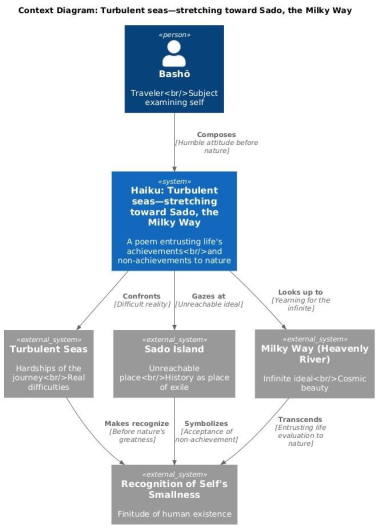
Diagram Explanation:
This poem deals with the experience of a magnificent natural landscape in Dewa Province. Turbulent seas (dynamic, difficult reality), Sado Island (unreachable place), and the Milky Way (infinite ideal) form a three-layer structure, within which the smallness of self-existence and a state beyond life evaluation are expressed. This addresses the end-of-life challenge of "integrating achievement and non-achievement." PlantUML Code:
@startuml
!include https://raw.githubusercontent.com/plantumlstdlib/C4-PlantUML/master/C4_Context.puml title Context Diagram: Turbulent seas-stretching toward Sado, the Milky Way
Person(Bashō, "Bashō", "Traveler
Subject examining self")
System(haiku, "Haiku: Turbulent seas-stretching toward Sado, the Milky Way", "A poem entrusting life's achievements
and non-achievements to nature")
System_Ext(araumi, "Turbulent Seas", "Hardships of the journey
Real difficulties")
System_Ext(sado, "Sado Island", "Unreachable
place
History as place of exile")
System_Ext(amanogawa, "Milky Way (Heavenly River)", "Infinite ideal
Cosmic beauty")
System_Ext(self_small, "Recognition of Self's Smallness",
Rel(haiku, amanogawa, "Looks up to", "Yearning for the evaluation to nature") infinite") @enduml
"Finitude of human existence") Rel(araumi, self_small, "Makes recognize", "Before na-
Rel(Bashō, haiku, "Composes", "Humble attitude before ture's greatness")
nature") Rel(sado, self_small, "Symbolizes", "Acceptance of non-
Rel(haiku, araumi, "Confronts", "Difficult reality") achievement")
Rel(haiku, sado, "Gazes at", "Unreachable ideal") Rel(amanogawa, self_small, "Transcends", "Entrusting life
Figure 7. Context Diagram of the Third Haiku ("Araumi ya..."). Context Diagram of the Third Haiku ("Araumi ya...").
5.3.2. Container Diagram (Container Layer)
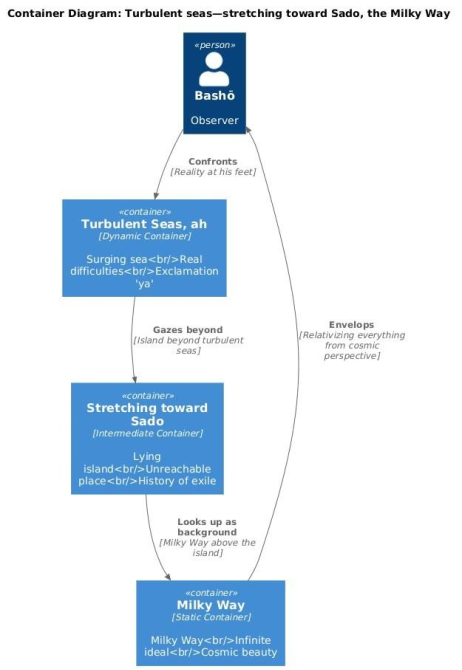
Diagram Explanation:
Three major containers composing the poem-"Turbulent seas, ah" (container of dynamic reality), "Stretching toward Sado" (intermediate/unreached container), and "Milky Way" (container of static ideal)-form a vertical spatial structure. The movement of gaze from sea to island, island to sky, symbolizes spiritual ascent from reality to ideal.
Plain explanation: Imagine standing on a shore. First you see the violent waves at your feet (present struggles), then your eyes move to the distant island you cannot reach (unfulfilled dreams), and finally you look up to the vast starry river in the sky (eternal perspective). This upward movement of vision mirrors the spiritual journey from immediate concerns to cosmic understanding.
PlantUML Code:
@startuml
!include https://raw.githubusercontent.com/plantumlstdlib/C4-PlantUML/master/C4_Container.puml title Container Diagram: Turbulent seas-stretching toward Sado, the
Milky Way
Person(Bashō, "Bashō", "Observer")
Container(araumi, "Turbulent Seas, ah", "Dynamic
Container", "Surging sea
Real difficulties
Exclamation 'ya'")
Container(sado, "Stretching toward Sado", "Intermediate Container", "Lying island
Unreachable place
History of exile")
Container(amanogawa, "Milky Way", "Static Container",
"Milky Way
Infinite ideal
Cosmic beauty")
Rel(Bashō, araumi, "Confronts", "Reality at his feet")
Rel(araumi, sado, "Gazes beyond", "Island beyond turbulent seas")
Rel(sado, amanogawa, "Looks up as background", "Milky
Way above the island")
Rel(amanogawa, Bashō, "Envelops", "Relativizing everything from cosmic perspective") @enduml
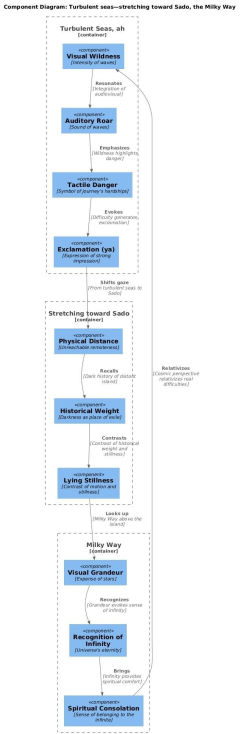
Figure 8. Container Diagram of the Third Haiku ("Araumi ya...").
5.3.3. Component Diagram (Component Layer)
Diagram Explanation:
We analyze the internal structure of each container in detail.
"Turbulent seas, ah" consists of "Visual wildness," "Auditory roar,"
"Tactile danger," and "Exclamation (ya)." "Stretching toward Sado" comprises "Physical distance," "Historical weight," and "Lying stillness." "Milky Way" includes "Visual grandeur," "Recognition of infinity," and "Spiritual consolation." The interaction of these elements forms the deep theme of life's summation. PlantUML Code:
@startuml
!include https://raw.githubusercontent.com/plantumlstdlib/C4-PlantUML/master/C4_Component.puml title Component Diagram: Turbulent seas-stretching toward Sado, the Milky Way Container_Boundary(araumi_boundary, "Turbulent Seas, ah") {
Component(visual_rough, "Visual Wildness", "Intensity of waves")
Component(sound, "Auditory Roar", "Sound of waves")
Component(danger, "Tactile Danger", "Symbol of journey's hardships")
Component(ya, "Exclamation (ya)", "Expression of strong impression") }
Container_Boundary(sado_boundary, "Stretching toward Sado") {
Component(distance, "Physical Distance", "Unreachable
Component(history, "Historical Weight", "Darkness as place of exile")
Component(lying, "Lying Stillness", "Contrast of motion and stillness") }
Container_Boundary(amanogawa_boundary, "Milky Way")
{
Component(vastness, "Visual Grandeur", "Expanse of stars")
Component(infinity, "Recognition of Infinity", "Universe's eternity")
Component(consolation, "Spiritual Consolation", "Sense of belonging to the infinite") }
Rel(visual_rough, sound, "Resonates", "Integration of audiovisual")
Rel(sound, danger, "Emphasizes", "Wildness highlights danger")
Rel(danger, ya, "Evokes", "Difficulty generates exclamation")
Rel(ya, distance, "Shifts gaze", "From turbulent seas to
Sado")
Rel(distance, history, "Recalls", "Dark history of distant island")
Rel(history, lying, "Contrasts", "Contrast of historical weight and stillness")
Rel(lying, vastness, "Looks up", "Milky Way above the island")
Rel(vastness, infinity, "Recognizes", "Grandeur evokes sense of infinity")
Rel(infinity, consolation, "Brings", "Infinity provides spiritual comfort")
Rel(consolation, visual_rough, "Relativizes", "Cosmic perspective relativizes real difficulties")
@enduml
Figure 9. Component. Diagram of the Third Haiku ("Araumi ya...").
5.3.4. Extraction of End-of-life Planning and Well-being Elements
Analysis Results:
Integration of Achievement and Non-Achievement:
The three-layer structure-turbulent seas (hardship), Sado (unreached), Milky Way (ideal)-presents a perspective accepting both "what was achieved" and "what was left undone" in life. This connects to "liberation from perfectionism" in end-of-life planning.
Relativization of Self:
By recognizing one's own smallness before magnificent nature, one liberates life evaluation from self-centered perspective. This is a higher stage of well-being: "transcendence of ego."
Devotion to Nature:
The sense of impermanence that entrusts everything to nature's order brings "peace of mind" through letting go of the desire for control. This is the core of spiritual preparation in end-of-life planning.
7. Comprehensive Evaluation: Common Themes Across the Three Haiku
Lessons on End-of-Life Planning and Well-Being Derived from the Haiku.
7.1. Common Structural Features Across the Three Haiku
C4 model analysis has revealed the following structural features common to all three haiku:
7.1.1. Movement from Duality to Integration
First haiku: Duality of life and death → Integration through nature (cherry blossoms)
Second haiku: Duality of unity and separation → Integration through time (autumn)
Third haiku: Duality of reality and ideal → Integration through cosmos (Milky Way)
All poems possess a structure where opposing elements are integrated through transcendent existence: nature (cherry blossoms), time (autumn), or space (Milky Way).
Plain explanation: Each poem starts with two opposite ideas that seem to conflict, but then finds a way to bring them together through something larger and eternal. It's like resolving an argument by stepping back and seeing the bigger picture.
7.1.2. Upward Movement of Perspective
In all three haiku, there is a shift in viewpoint from personal/concrete level to universal/abstract level:
First haiku: Self's life → Essence of life in general
Second haiku: Personal parting → Cosmic impermanence
Third haiku: Journey's hardships → Cosmic perspective
This "elevation of perspective" symbolizes the spiritual process in end-of-life planning of transcending self-centeredness and reconsidering life in a larger context.
7.1.3. Emotional Sublimation Through Exclamatory Expressions
All three haiku use exclamatory expressions (kana, zo, ya) to achieve deep emotional expression and sublimation beyond mere description. This is noteworthy as a technique for "emotional integration" in end-of-life planning.
Note for international readers: These exclamatory particles (kana, zo, ya) don't translate directly into English, but they function like musical notes that add emotional resonance to the meaning-similar to how "Oh!" or "Ah!" can transform a simple statement into something deeply felt.
7.2. Lessons for End-of-life Planning
From analysis of the three haiku, the following lessons applicable to contemporary end-of-life planning emerge:
Lesson 1: Don't Seek Perfection (Acceptance of Non-
Achievement)
As symbolized in "Turbulent seas-stretching toward Sado, the Milky Way," the attitude of not denying the unreachable ideal (Sado) but looking up at the entirety (Milky Way) that includes it demonstrates "accepting non-achievement in life and affirming one's life including that"-a core attitude in end-of-life planning.
Contemporary people often suffer from seeking "perfect end-of-life planning." Bashō's poem teaches that "accepting the totality of life, including both achievement and nonachievement" is true well-being.
Lesson 2: Gratitude for Relationships and Practicing Parting
"Like a clam's shell at Futami, we part as autumn departs" recognizes the relationship with an important person as a deep bond- "paired as one"-while accepting that parting by overlaying it with autumn's end, nature's order. This demonstrates the important end-of-life task of "accepting both gratitude for relationships and the inevitability of parting."
In end-of-life workshops, this poem enables practice
| [10] | Alfons Deeken (2001) How to Face Death, NHK Publishing. |
| [11] | Shimizu, Tetsuro (2017) Living in an Aging Society: Those Who Age, Those Who Witness Death, Nihon Hyoronsha. |
[10, 11]
of both "gratitude for important people" and "mental preparation for eventual parting."
Lesson 3: Living in This Present Moment (Mindfulness)
The present progressive form "living" (ikitaru) in "Living within two lives-the cherry blossoms" expresses the attitude of "living this moment with full strength" while being aware of death. This resonates deeply with the contemporary concept of mindfulness.
End-of-life planning is "preparation for death," but paradoxically it is also "living the present more deeply." Bashō's poem shows these two are not contradictory.
Lesson 4: Peace of Mind Through Devotion to Natu
In all three haiku, by positioning one's existence in the larger context of nature (cherry blossoms, autumn, Milky Way), one attains "a sense of belonging to something greater" that transcends loneliness and anxiety.
In today's secularized society, many people lack religious devotion. Bashō's poems show that devotion to nature can be a universal spiritual support, providing a practical anchor for the mind in end-of-life planning.
7.3. Structure of Well-being
From analysis of the three haiku, the structure of well-being in end-of-life planning can be organized as follows:
[Level 1: Acceptance]
Acceptance of life-death duality (First haiku)
Acceptance of parting's inevitability (Second haiku)
Acceptance of non-achievement (Third haiku)
[Level 2: Integration]
Integration of opposing elements (life and death, unity and separation, reality and ideal)
Emotional sublimation (through exclamatory expressions)
Integration of past, present, and future
[Level 3: Transcendence]
Devotion to nature
Transcendence of self-centeredness
Attainment of cosmic perspective
[Result: Spiritual Well-Being]
Peace of mind
Liberation from loneliness
Affirmation of life
This three-level structure can be utilized as a roadmap for spiritual growth in end-of-life planning. This resonates deeply with the contemporary concept of mindfulness
| [9] | Viktor E. Frankl (1956/2002) Man's Search for Meaning, Misuzu Shobo. |
[9]
.
7.4. Implications for Contemporary Society
The wisdom of end-of-life planning shown in Bashō's poems includes implications for the following contemporary challenges:
1. Spiritual Care in an Aging Society:
The importance of spiritual well-being in addition to physical support through medical care and nursing
2. Humanity in the Digital Age:
The value of "acceptance," "space," and "non-action" beyond efficiency and optimization
3. Globalization and Cultural Identity:
Contemporary re-evaluation of traditional Japanese wisdom (haiku, nature views)
| [12] | Kato, Shuichi (1997) Introduction to Japanese Literary History, Chikuma Shobo. |
| [13] | Konishi, Jinichi (1985) Japanese Literary History, Kodansha Gakujutsu Bunko. |
[12, 13]
.
4. Spirituality in a Secular Society:
Exploration of universal spiritual support not dependent on religion




 Share This Article
 Twitter
 Linked In
 Facebook
 Copy
Copy Download